
OnlyFans free pages promise zero entry cost, but the spending they generate often exceeds a paid subscription. A free page sets its subscription price to $0 and earns through pay-per-view (PPV) messages and tips instead. That structure removes the upfront payment that normally makes a buyer pause and think. This guide identifies the traps inside zero-entry pricing and the prevention strategies that keep monthly costs predictable.
Every unlocked message, every tip, and every custom request is a separate transaction, and small amounts add up faster than a single monthly charge. BestOnlyFans tracks these patterns across free and paid pages, and the data consistently shows that unmanaged free-page spending runs higher than a fixed subscription. The sections below break down why that happens and how to stop it. BestOnlyFans refreshes its rankings every month.

The Psychology of Zero-Entry Pricing
A paid subscription creates a mental accounting entry the moment it is purchased. The subscriber knows the exact monthly figure, and every additional purchase feels like spending on top of an existing cost. A free page has no such anchor. The budget line item does not exist until the first unlock, and by then the psychological barrier has already been crossed once.
Price sensitivity drops with each individual transaction. A $5 message unlock does not register the same way a $10 monthly subscription does, even though the unlock is smaller. The subscription is a repeated, visible commitment.
Sunk cost perception works in reverse here. Paid subscribers often feel pressure to use what they already bought, which caps additional spending. Free-page users have nothing to justify, so there is no natural stopping point. Transaction friction is also lower because payment details are already stored and unlocking takes one tap.
| Behavioral Factor | Free Page Effect | Paid Page Equivalent |
|---|---|---|
| Mental accounting | No budget entry until first unlock | Fixed monthly line item from day one |
| Sunk cost perception | No prior cost to justify further spending | Existing fee encourages use, caps extras |
| Transaction friction | Stored payment, one-tap unlocks | Same friction, fewer transactions |
| Budget visibility | Spending scattered across creators | Single known recurring figure |
Budget visibility is the last piece. A free-page user who unlocked six messages across three creators usually cannot recall the running total. That gap between actual and perceived spending is where zero-entry traps live, and it widens with every additional page followed.
PPV Accumulation Mechanics
PPV messages unlock up to $50 each, though most sit far below that ceiling. Paid chat commonly runs $3 to $5 per message, and tips can reach $100. The danger is not any single price. It is the compounding effect when one user follows several free pages at once.
Consider a realistic week. A user follows five free pages. Three of them send two PPV messages each, priced between $5 and $12. That is six unlocks in seven days, and at a $7 average the week closes near $42. Nothing in that pattern feels excessive in the moment, yet the monthly total lands between $150 and $180.

Five factors accelerate this accumulation, and each one is designed to shorten the decision window:
- Time-gated message expiration, which pushes users to unlock before an offer disappears.
- Social proof indicators on unlock buttons, showing how many others already paid.
- Sequential content teasers that split one set into several paid messages.
- Direct creator messaging pressure, where a personal reply arrives with a price attached.
- Fear of missing exclusive windows that exist only for a few hours.
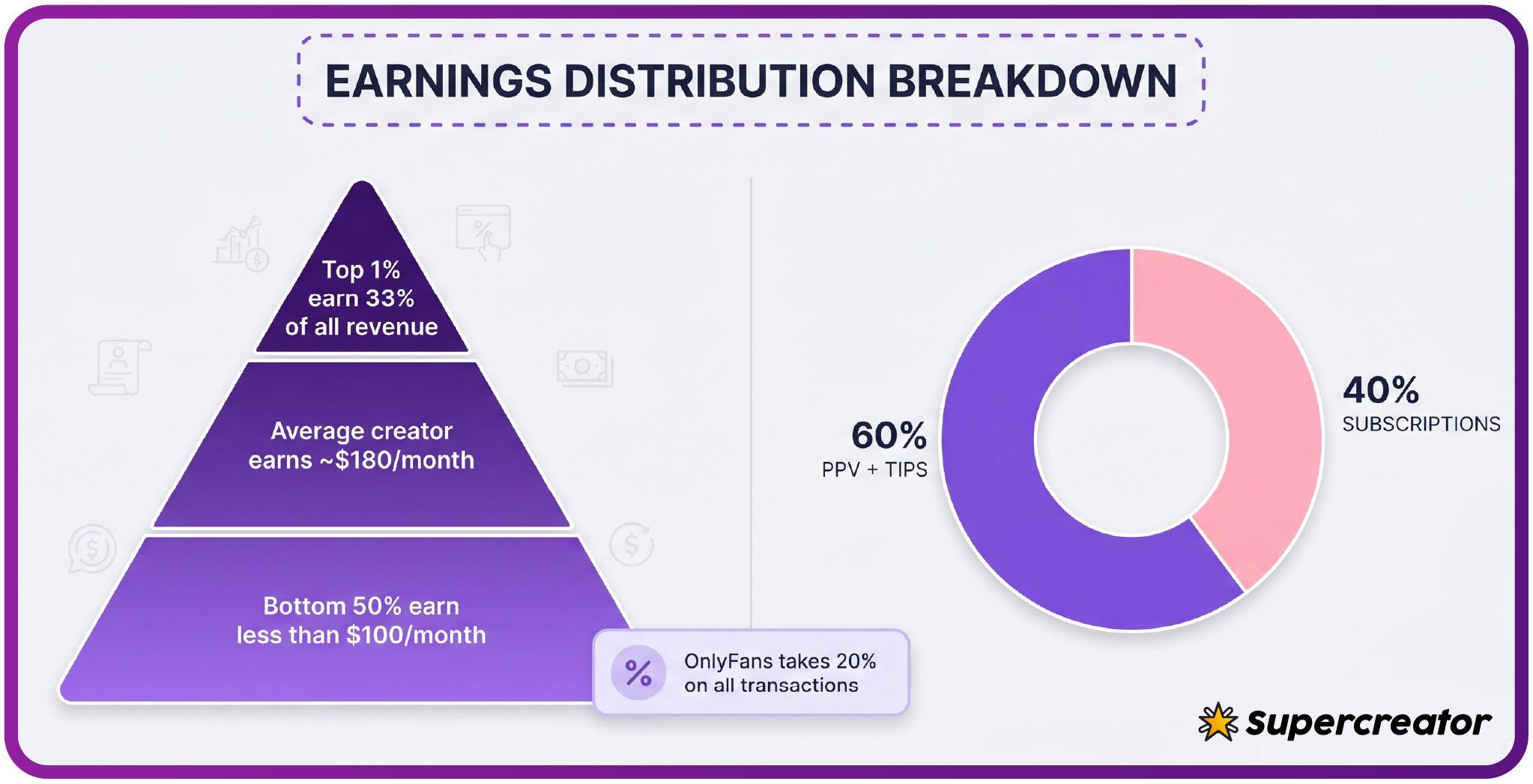
The platform takes 20% of everything, and the creator keeps 80%, so the incentive to send frequent paid messages is structural rather than personal. It is simply how a free page converts attention into revenue across a week of small decisions.
Tip: Track unlocks by creator, not by total. A single creator usually accounts for most of the monthly spend, and cutting that one page often fixes the entire budget.
Comparative Cost Scenarios
The four archetypes below cover most free-page users, from occasional browsing to exclusive custom requests. The paid-page column assumes a standard subscription at a typical price between $4.99 and $15.
- Light user: $0 to $15 per month on free pages, mostly tips and one or two unlocks.
- Moderate user: $30 to $50 per month across a mix of free and paid pages.
- Heavy PPV user: $75 to $150 per month on free pages only, no subscriptions at all.
- Controlled paid subscriber: $20 to $40 per month with one or two subscriptions and zero PPV.
The heavy PPV user pays more than any subscriber while receiving no recurring access guarantee, because free-page content is not owned or scheduled.
| Usage Pattern | Free-Page Monthly Range | Paid-Page Equivalent |
|---|---|---|
| Casual browsing | $0 to $15 | $4.99 to $9.99 subscription |
| Moderate engagement | $30 to $50 | $9.99 to $15 subscription plus tips |
| Heavy PPV purchasing | $75 to $150 | Two subscriptions, $20 to $30 total |
| Exclusive custom content | $100 and above | Custom pricing on top of any subscription |
One structural detail matters here. When a creator raises the price, auto-renew stops and existing access lasts until the paid period ends. Free pages have no equivalent mechanism, because there is no renewal to stop.
Hard Budget Control Methods
Willpower is a weak control when payment details are stored and unlocking takes one tap. Technical limits work better because they fail before the decision, not after it.
- Prepaid card monthly loading limits: load one fixed amount per month and let the card decline when it runs out.
- Wallet credit caps with auto-pause: set a ceiling on stored credit so unlocks stop automatically at the limit.
- Notification batching to reduce impulse triggers: disable push alerts and check messages once per day instead.
- Weekly spending reconciliation calendar blocks: a fifteen-minute review every week that totals unlocks by creator.
The card verification hold is $0.10 and is refunded within days, so attaching a prepaid card costs nothing beyond the temporary hold. This is the single most effective isolation method, because a declined card ends the transaction before any content is unlocked.

Two-step authentication also deserves a place in the routine here. Phishing attempts that mimic login screens are common in this space, and the Federal Trade Commission publishes guidance on recognizing them through this breakdown of phishing scams. Legitimate platforms never ask for a password through a direct message.
Creator-Level Spending Assessment
Some creators send occasional PPV messages, and others send several per week with short expiration windows. Five criteria help separate one from the other before any money is spent.
- PPV message density in recent posts: count how many paid messages arrived in the last thirty days.
- Tip goal frequency versus content delivery: check whether stated goals translate into posted content.
- Custom content turnaround quotes: compare quoted prices and timelines against the stated offer.
- Fan comment sentiment on value: read public replies for repeated complaints about pricing.
- Free-to-paid conversion history: note whether the page has changed its pricing structure recently.
A page that sends ten PPV messages a month at $8 each is an $80 monthly relationship before tips. Price per unlock matters far less than how often unlocks appear in a follower’s inbox.
This ranking methodology is the same approach BestOnlyFans uses when comparing pages for value, and it treats message frequency as the leading indicator of total cost. If the goal is to find pages that deliver consistent value without constant paid messaging, a structured free onlyfans method is worth reading before following any new page. It covers how to compare pages on cost per month rather than cost per message.

Recovery Protocols After Overruns
An overrun month is not a failure of character, it is a signal that the controls were too loose.
- Immediate creator list audit by cumulative spend, ranked from highest to lowest.
- Temporary message notification muting across every free page for two weeks.
- Prepaid card switch with a reduced load, set below the target monthly figure.
- Thirty-day spending diary to identify which trigger patterns precede unlocks.
The audit usually produces an uncomfortable result. Two or three pages account for most of the spend, and the rest are minor. Unfollowing the top page typically removes half the monthly cost without any other change.
Notification muting addresses the timing problem. Most unlocks happen within minutes of a message arriving, so delaying awareness by hours removes the impulse window entirely.
If a subscription was involved, the cancellation path is straightforward and the cancellation reasons list exists mainly for platform data. Free pages have no equivalent ending point, which is why the audit and the card switch carry the whole recovery load.
Platform History and Why Ranking Sites Exist
OnlyFans launched in 2016 and grew sharply through 2020, and that growth changed how users find pages. The platform has no built-in discovery feed or directory, which is why third-party ranking sites exist at all.

That gap matters for spending. Without a directory, users find pages through links and rankings, and they often follow several at once without comparing cost profiles. The zero-entry model then does the rest. A user who would never subscribe to five paid pages will happily follow five free ones and unlock messages across all of them.
Free access is a pricing model, not a discount, and it is designed to move revenue from the subscription line to the transaction line. That is a legitimate model with real costs attached, and the controls above are simply the tool for keeping those costs inside a planned figure.

FAQ
How do free OnlyFans pages generate revenue without subscriptions?
Free pages set the subscription price to $0 and earn through PPV messages, tips, and paid chat. The platform takes 20% of every transaction and the creator keeps 80%.
What is a typical monthly spending range for active free-page users?
Light users spend $0 to $15 per month, moderate users $30 to $50, and heavy PPV users $75 to $150 or more. The range widens with the number of free pages followed, because every page adds its own message stream.
Can spending on free pages exceed paid subscription costs?
Yes, and it commonly does. A paid subscription runs $4.99 to $49.99 per month, with most clustering between $5 and $10. A free-page user who unlocks six messages a week at $7 each spends roughly $168 per month.
What technical controls prevent PPV overspending?
Prepaid cards with fixed monthly loads, wallet credit caps with auto-pause, batched notifications, and a weekly reconciliation block cover most cases.